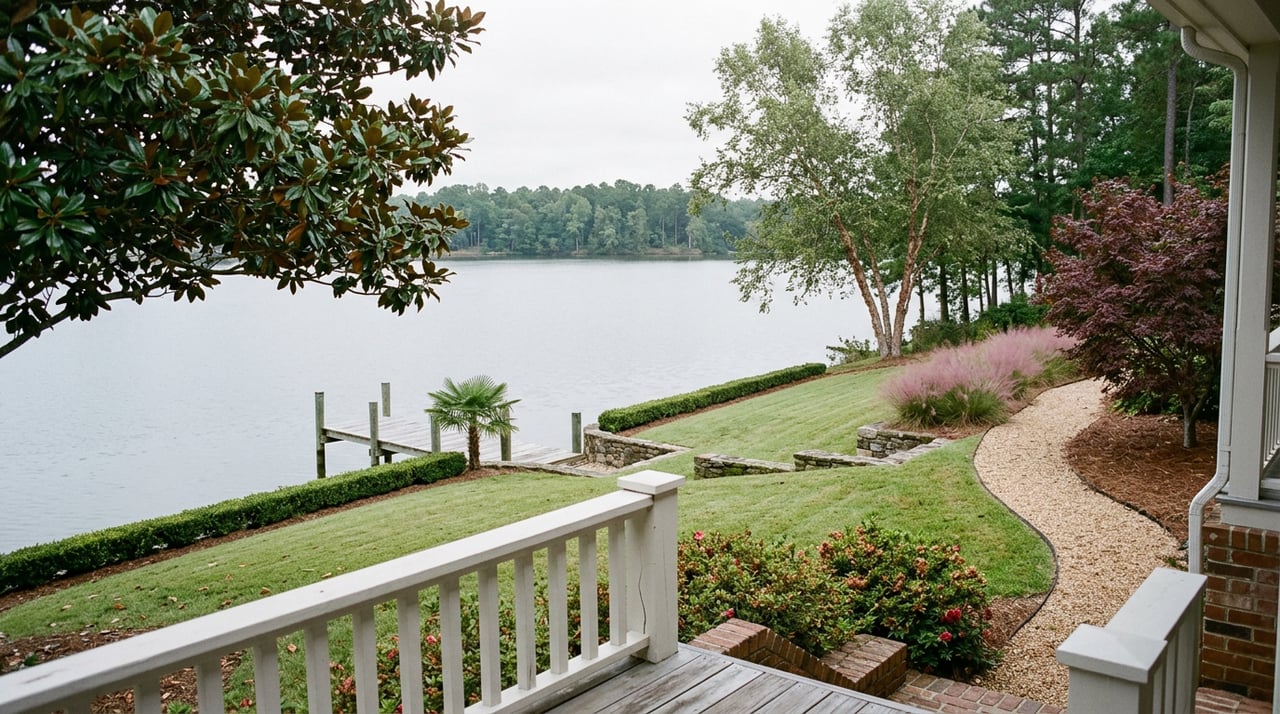
Two homes on Lake Lanier can sit less than a mile apart, carry similar square footage, and close a year apart for a difference of half a million dollars. Ask most buyers why, and they'll point to the map: Forsyth County schools, Hall County taxes, the Cumming side versus the Gainesville side. That story is comfortable and it is largely wrong. The line that actually splits Lanier's prices runs along the shoreline itself, not along a county border, and it has almost nothing to do with which school district collects your child's homework.
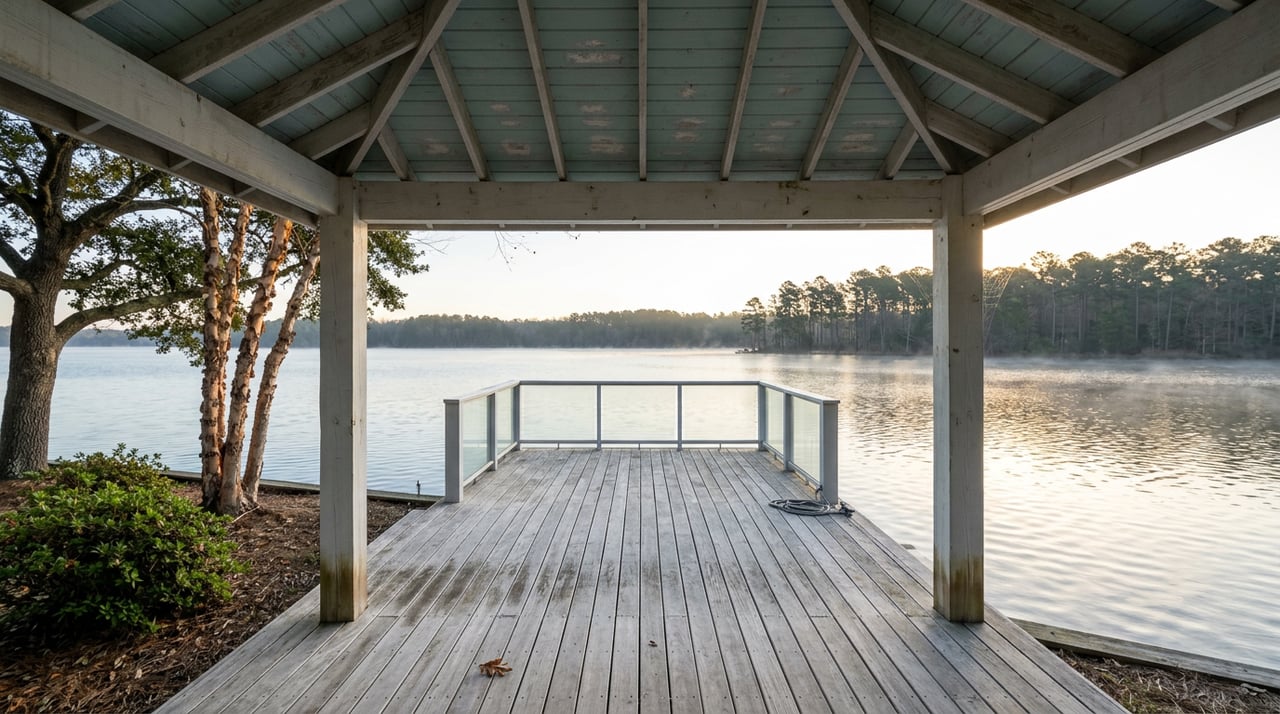
The real variable is what's under the dock, and whether you're legally allowed to have one at all.
The County-Line Story Buyers Tell Themselves
The county narrative isn't baseless. One 2026 breakdown of lake-area listings put Forsyth County's Lake Lanier median around $668,000, against roughly $475,000 in Hall County, a gap that tracks with shorter Atlanta commutes and Forsyth's school reputation. Meanwhile, a broader look at the lake as a whole, covering both waterfront and inland properties inside Lake Lanier area school zones, put the median closer to $955,000 as of April 2026.
Stack those numbers next to each other and they don't reconcile cleanly. A county-level median a third lower than the lake-wide median isn't telling you Hall County is cheap. It's telling you the county figure is being dragged down by something the school-district story can't explain: a large share of Hall County's lakefront inventory doesn't carry a usable dock at all.
The Real Fault Line Runs Along The Shoreline
Here's the number that actually organizes the market: waterfront homes with a single-slip permitted dock closed at a median near $1,150,000 in the core Lake Lanier ZIP codes as of March 2026. Homes with a double-slip permit closed closer to $1,425,000. Homes on the same shoreline with lake access but no private dock permit, meaning you can see the water and maybe walk to it but you can't legally tie up a boat, closed at a median around $675,000.
That's a gap of $475,000 to $750,000 depending on slip class, inside the same ZIP codes, often inside the same subdivision.
A modest house on a permitted deep-water lot routinely outsells a larger, updated house one cove over that never got a dock. The house is not the asset. The permit is.
County lines never enter that equation. A no-dock lot in Forsyth costs about the same relative to a permitted lot in Forsyth as a no-dock lot in Hall costs relative to a permitted lot in Hall. The variable that moves the number is the same on both sides of the water.
What The Permit Cap Actually Locks In
The reason dock status carries this much weight is that it isn't a matter of taste. It's a hard supply constraint. Under the 2004 Lake Lanier Shoreline Management Plan, the U.S. Army Corps of Engineers capped private dock permits on the entire lake at 10,615. Once that ceiling was reached, the Corps stopped issuing new ones.
The wind-down happened in stages that local papers tracked in real time. The Gainesville Times reported in late 2015 that the number of available permits had fallen to about 30, with rangers processing a first-come, first-served list. The following year, the Forsyth County News covered the cap reaching its full 10,615 total, noting a waiting list of roughly 170 people hoping for a site review even after new permits had stopped.
There is no meaningful path to a brand-new permit on Lake Lanier today. If a lot doesn't already carry one, the water access is real but the dock is not, no matter how the listing photos are cropped. That's a fixed ceiling in a way a school district rating never is. Schools can improve. A shoreline management cap set two decades ago does not expand because a buyer wants it to.
Where The Deep Water Actually Sits
Permit status is only half of the equation. The Corps draws the lake down every winter for flood storage, typically from the 1,071-foot summer full pool to somewhere in the 1,060 to 1,065-foot range. A permitted dock in a shallow cove can end up sitting on dry ground for months. A permitted dock on deep water keeps floating all year.
The deepest, most reliable shoreline concentrates in a few specific stretches:
- The main channel between Buford Dam, Lanier Islands, and Aqualand Marina on the lake's south end
- The north Forsyth shoreline near Browns Bridge Road
- Hall County shoreline above Holiday Marina and Sunrise Cove Marina
Buyers touring in July won't see the difference. Buyers who check depth against winter drawdown numbers will.
Five Communities, Five Different Bets
Naming the shoreline zones only helps if you can attach them to somewhere you'd actually live. A few established communities illustrate how differently this plays out depending on what you're optimizing for.
| Community | County | What defines it | Best fit |
|---|---|---|---|
| Harbour Point | Hall | Peninsula setting with water on three sides and some of the deepest, most protected dock positions on the lake | Buyers who want maximum dock reliability |
| Chestatee Golf Community | Hall/Forsyth line | Golf course paired with lake access on Chestatee Bay | Buyers weighing golf against pure waterfront |
| WaterMark | Dawson | Newer construction on the Chestatee River, known for clear water | Buyers prioritizing lower property taxes |
| Marina Bay | Hall (Gainesville) | Built around a 280-slip marina with HOA amenities | Buyers who want marina convenience without a private dock |
| Cresswind at Lake Lanier | Hall (Gainesville) | Active adult 55-plus community | Retirees prioritizing lifestyle over boat storage |
None of that hierarchy is a county story. It's a shoreline-position and amenity-structure story that happens to cross county lines freely.
The Tax Line Nobody Budgets For
Hall County adds one more wrinkle that catches buyers who did their homework on schools and dock permits but never looked at the tax mechanics. Hall County assesses a portion of waterfront property value based on the physical length of shoreline frontage, independent of home size or condition. A 200-foot-frontage lot carries a structurally higher tax basis than a 75-foot lot next door, even if the houses are identical.
The Gainesville Times documented exactly how sharp that can get. In a 2017 report on countywide reassessments, a Duckett Mill Road property owner named Kim Fortney described his land alone jumping from a $154,600 appraisal to $618,000 after the county's review of Lake Lanier parcels, on a two-acre lot with about 150 feet of lakefront he'd purchased decades earlier. In the same piece, a Harbour Point homeowner named Jeremy Ewers described a 30 percent single-year increase on his own assessment. Neither owner had done anything to the house. The shoreline itself had moved the number.
That mechanism hasn't gone away. It's simply invisible until you're staring at a notice with your own name on it.
The Gap Inside Lanier Is Bigger Than The Gap Between Lakes
Here's the detail that should reframe how you think about the whole search. Waterfront medians at Lake Hartwell, roughly ninety minutes southeast, run between about $750,000 and $794,000, against Lanier's lake-wide range of roughly $955,000 to $1,000,000. That's a real gap, and it largely reflects Lanier's 45 to 60-minute commute to Atlanta via GA-400 or I-985 against Hartwell's hour and a half to two hours.
Now compare that cross-lake gap, a few hundred thousand dollars, to the $475,000 to $750,000 spread between a permitted dock and a no-dock lot on Lanier itself. The variance inside one lake, driven by permit status and water depth, is often as large or larger than the variance between two entirely different lakes an hour and a half apart. If you're shopping Lanier because of proximity to Atlanta, the permit and depth questions matter more to your final price than the drive time you were originally solving for.
As of mid-August 2026, the lake sits around 1,066 to 1,067 feet, roughly 4 to 5 feet below the 1,071-foot full pool, according to public USGS gauge readings tracked at lakelanierwater.com. That's a normal late-summer number, not a drought signal, but it's exactly the kind of reading worth checking before you tour a cove lot rather than after.
A Few Questions Before You Write An Offer
Does a bigger house always cost more on the lake? Not reliably. A modest home on a permitted deep-water lot has repeatedly outsold larger homes on shallow, no-dock parcels in the same ZIP code.
Can I apply for a new dock permit if the lot doesn't have one? No. The Corps' 10,615-permit cap under the 2004 Shoreline Management Plan has been full for years, and there is no functioning waitlist that guarantees a new one.
Does the county line matter at all? Yes, for schools and for the Hall County frontage-based tax assessment specifically. It just isn't the primary force behind the biggest price gaps you'll see between comparable listings.
Lake Lanier rewards buyers who ask about water depth and permit class before they ask about kitchen finishes. If you're comparing coves and counties and want someone who reads a listing the way the Corps reads a shoreline file, Jennifer Anderson has spent years untangling exactly this kind of Lanier math for buyers and sellers. Let's Connect. Start Your Georgia Home Story.